
BubbleRAN’s SMO-Sphere is built on a simple principle: network automation should start from what the operator wants to achieve, not from long manual procedures, static scripts, or disconnected operational tools. In our recent webinar on network automation, we showed how a declarative and cloud-native approach makes this practical, from Day 0 planning to Day 2+ lifecycle management.
In SMO-Sphere, automation is modeled declaratively. Operators express the desired outcome as intent, mapped into Kubernetes custom resources representing services, slices, networks, and terminals. The platform then continuously reconciles the current state of the network with the target state. Built on the Kubernetes Operator pattern, SMO-Sphere treats deployment, assurance, scaling, and change management as part of one continuous automation loop rather than separate workflows.
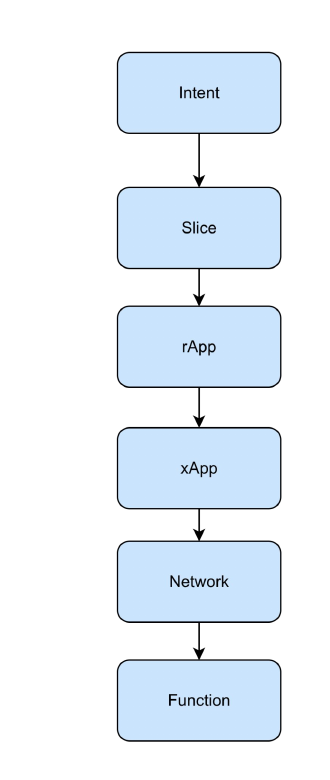
Automation spans multiple layers of abstraction. A service intent can be translated into slice lifecycle actions, rApps, xApps, network blueprints, and ultimately deployed network functions. High-level entities such as ServiceProfile capture service objectives such as latency, throughput, or policy requirements. These are mapped into deployable SliceProfile definitions and then into domain-specific blueprints describing how the target RAN, Edge, and Core functions should be composed and deployed. This keeps operations simple, even when the underlying infrastructure is not.
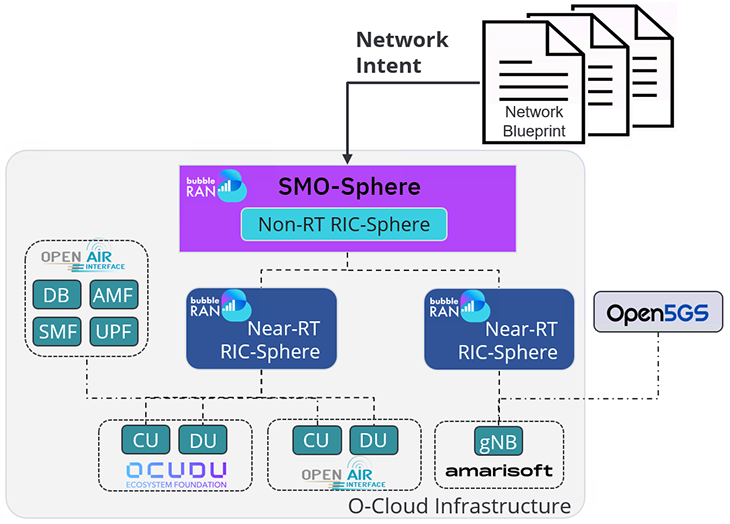
This approach allows BubbleRAN to realize network intent across heterogeneous, multi-vendor networks. The same automation framework can concurrently manage and operate deployments spanning the radio access network (RAN), Edge, Core Network (CN), and terminal services. In the same deployment, open-source 5G stacks such as the LFN Duranta project (formerly OpenAirInterface), the LF OCUDU project (formerly srsRAN), and Open5GS CN can be used for non-critical communications, while industrial-grade stacks such as LITEON small cells and Amarisoft vRAN can support other requirements.
It also supports partial-domain automation. For example, BubbleRAN SMO can manage the lifecycle of the RAN while connecting to an external Core already in place. This is especially valuable in brownfield environments, where operators want to introduce automation without replacing the full stack.
The key enabler is the network blueprint model and the separation of network composition from network deployment. Composition is typically defined by vendors, system integrators, or telco application providers, while deployment is driven by operator requirements and policies. In BubbleRAN, a network blueprint defines how each domain of the target network is assembled, while reusable composition models describe how the underlying functions should be instantiated and operated. This gives operators control over planning, configuration, integration, and evolution without locking them into a vertically integrated stack.
Automation is the ability to translate intent into deployment, assurance, scaling, and policy-driven actions. Autonomous networks go one step further: they require observation, reasoning, decision-making, and closed-loop adaptation over time. In practice, autonomy is not a sudden jump, but a progression from manual to assisted, to automated, and eventually to autonomous operations. Network automation is therefore the foundation for autonomous networks.
At BubbleRAN, this evolution is aligned with an agentic approach to network operations. AI agents can interpret high-level intents, decompose them into domain-specific actions, and coordinate workflows across the network. Together with rApps, xApps, digital twins, and specialized controllers, these agents provide a practical path toward closed-loop assistance, optimization, and progressively autonomous operations.
This is where MX-AI extends the automation foundation of SMO-Sphere. Built on the same declarative and intent-driven model, MX-AI brings agentic workflows, network assistance, and AI-driven optimization to support more adaptive, data-driven, and progressively autonomous operations.
The move toward autonomous networks should not come at the expense of openness or operator control. BubbleRAN supports third-party network functions, external workloads, and manual intervention whenever needed. The result is a platform that delivers repeatable automation while remaining flexible enough for brownfield integration, custom extensions, and multi-vendor environments.
That is the direction we believe matters most: not automation for its own sake, but a practical path toward autonomous networks grounded in declarative intent, lifecycle control, interoperability, and native support for AI-driven intelligence.
Watch our webinar on Network Automation