🏷️ Request a quotation
Campus-scale platform with enterprise O-Cloud, site-scoped indoor and outdoor O-RUs, synchronized fronthaul, GPU acceleration, agentic AI-RAN, Network Digital Twin, energy management, and one year of updates and support



MX-PDK CAMPUS gives operators, vendors, system integrators, enterprises, and large R&D programmes a complete, licensed, and validated multi-vendor 5G/6G O-RAN and AI-RAN platform at campus scale. It combines enterprise cloud infrastructure, indoor and outdoor radio coverage, programmable RAN control, agentic automation, GPU acceleration, and Network Digital Twin capabilities in one integrated environment.
It extends the full MX-PDK O-RAN and AI-RAN foundation with 3+ enterprise O-Cloud nodes, site-scoped O-RUs, on-premises GPU acceleration, the Observability, Automation, and Optimization Blueprints, MX-DT and its Scenario Kit, PDU-based energy visibility, and deployment services. It is designed for campus deployments, field validation, pre-production, and continuous optimization without changing the software foundation used across the MX-PDK range.
What makes MX-PDK CAMPUS different
- Scale: Move from a lab testbed to indoor and outdoor site coverage with enterprise compute, synchronized O-RAN fronthaul, commercial devices, and multi-cell configurations.
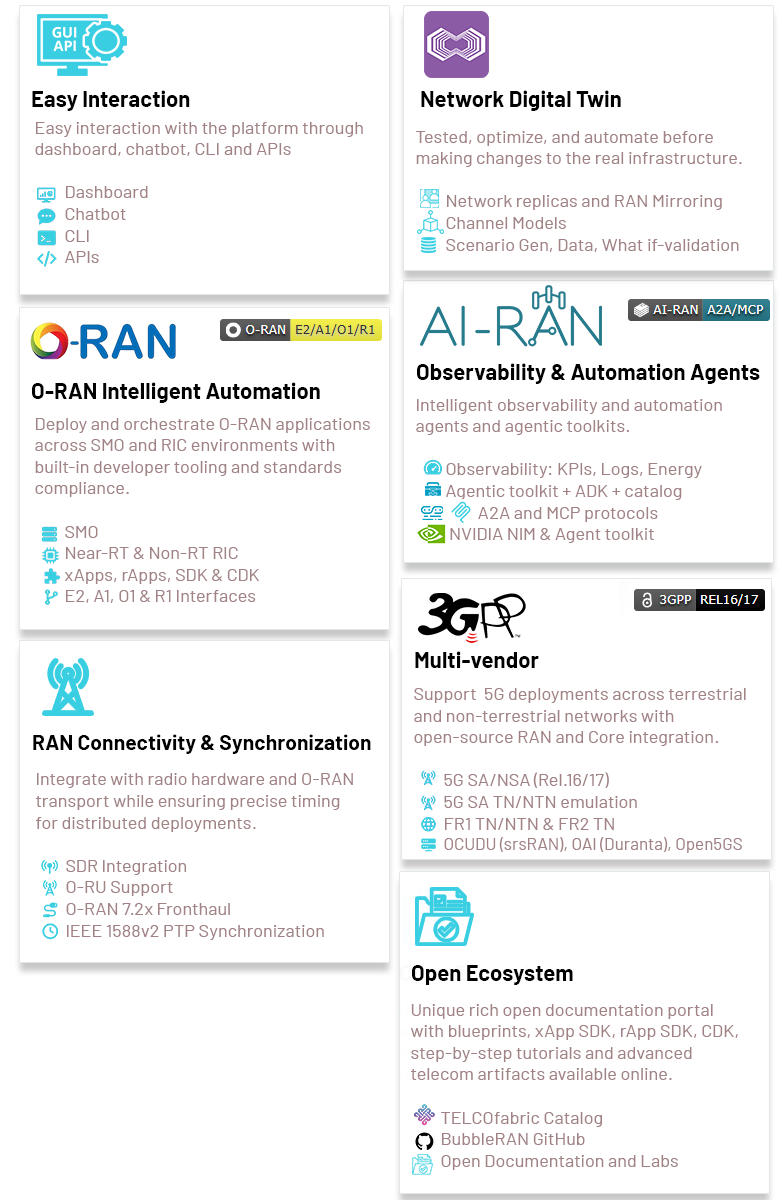
- O-RAN: Use the SMO/OAM, near-RT RIC, non-RT RIC, xApp SDK, rApp SDK, and CDK, with support for E2, A1, O1, R1, and O-RAN 7.2 fronthaul.
- AI-RAN: Run Observability, Automation, and Optimization Blueprints, build custom agents with the BAT Agent DevKit, and connect agents to network data and control through A2A and MCP.
- Network Digital Twin: Replicate live network scenarios, run what-if experiments, validate proposed changes, and use the MX-DT Scenario Kit for repeatable Digital Twin workflows.
- Infrastructure: Combine network, cloud, application, and per-node energy data, with PDU monitoring and control integrated through the SMO.
What can you do with MX-PDK CAMPUS?
- Deploy and validate campus-scale 5G networks using indoor and outdoor O-RAN radios, multiple cells, commercial devices, and end-to-end network slicing.
- Test multi-vendor O-RAN interoperability across the O-Cloud, O-CU/O-DU, O-RUs, RIC, SMO/OAM, fronthaul fabric, and commercial UE domains.
- Run agentic AI-RAN workflows for observability, automation, configuration, SLA assurance, slicing, mobility, and network optimization.
- Validate changes against a Network Digital Twin before applying them to the live network, supporting safer what-if analysis and closed-loop optimization.
- Experiment with advanced 5G/6G use cases, including TN/NTN, ISAC, sensing, mobility, V2X, industrial IoT, edge AI, and applications in the loop.
- Measure infrastructure and energy behavior across the network and O-Cloud, including per-node power visibility and control.
- Prepare field trials and pre-production deployments on the same software foundation used throughout the MX-PDK product family.
What arrives in the deployment?
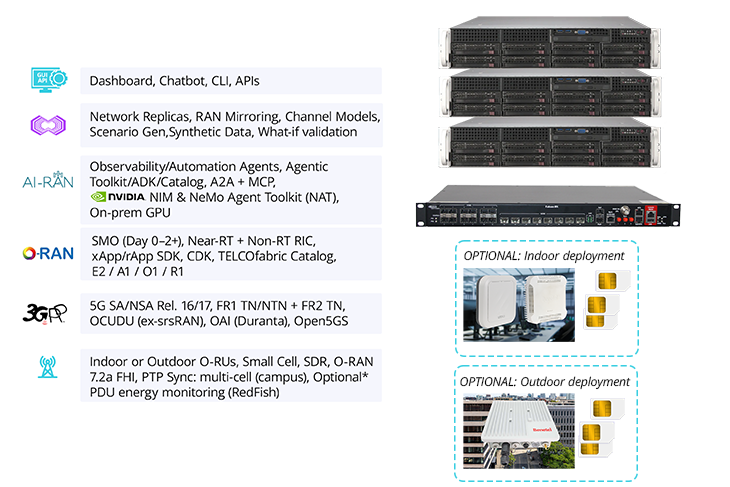
MX-PDK CAMPUS hardware
A CAMPUS configuration is scoped to the site and programme. A typical reference deployment includes:
- 3+ enterprise 2U O-Cloud server nodes, fully installed with the BubbleRAN O-Cloud, optimized Kubernetes, device discovery, Cilium networking, Multus, eBPF observability, and persistent storage. Additional nodes can be added when more capacity is required.
- Indoor and outdoor O-RAN 7.2 Radio Units, with LITEON FlexFi and supported Benetel indoor radios for in-building coverage, plus Benetel outdoor radios such as the RAN650 for campus and open-air deployments.
- 1x FibroLAN Falcon-RX fronthaul and synchronization fabric, with PTP grandmaster, GPS and local synchronization, PTP switching, QoS, and VLAN support.
- On-premises NVIDIA GPU acceleration, sized to the project for AI-RAN, agent inference, edge AI, and Digital Twin workloads, with NVIDIA RTX PRO 6000 Blackwell class as a reference configuration.
- Power Distribution Unit, integrated with the BubbleRAN SMO through Redfish for per-node power monitoring and control across the O-Cloud.
- Commercial device fleet and 20-SIM pool, using Quectel modules, Pictel edge nodes, and commercial devices for multi-UE, mobility, slicing, and application testing.
- Required deployment accessories, including antennas, RF, Ethernet and optical cables, SFPs, power supplies, adapters, and site-specific connectivity accessories.
The hardware configuration can be extended with additional O-Cloud nodes, GPUs, indoor or outdoor O-RUs, SDRs, commercial UEs and CPEs, edge devices, and multi-site configurations.
MX-PDK CAMPUS software
MX-PDK CAMPUS support, software updates, and services
The MX-PDK software license includes one year of software updates and technical support. The reference CAMPUS scope also includes a one-year hardware warranty. Site survey, installation, integration, hands-on training, feature development, and developer-level support can be scoped to the deployment requirements.
Your day-one blueprint
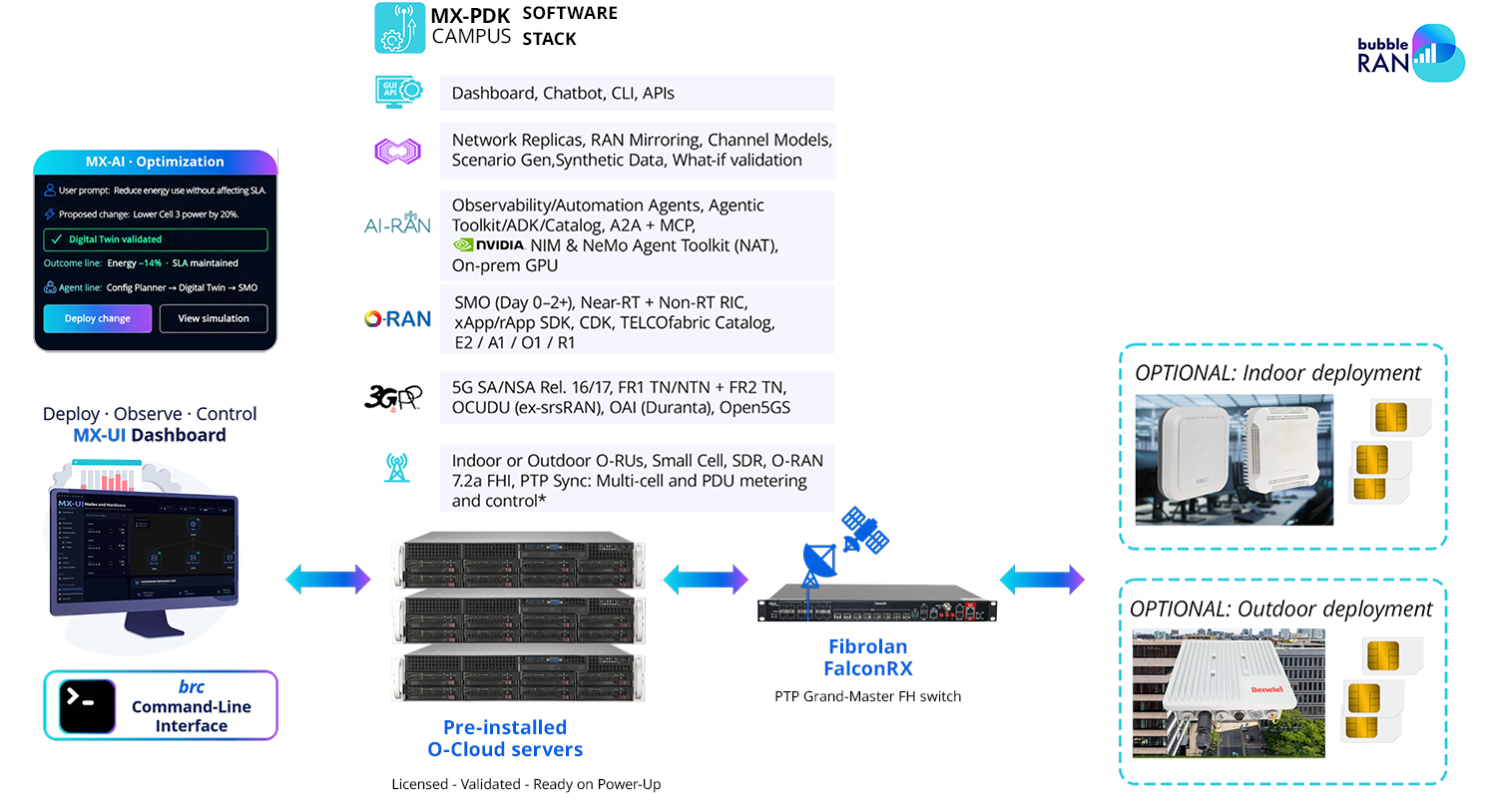
MX-PDK CAMPUS is delivered as a site-scoped platform with reusable deployment blueprints for multi-cell networking, slicing, agentic operations, and Digital Twin workflows. A reference blueprint combines a live campus network with end-to-end slices and the Optimization Blueprint, so proposed configuration changes can be evaluated against a synchronized Digital Twin before rollout.
bash$ brc install network 5g-campus.yaml       # deploy the multi-cell campus network
bash$ brc install slices campus-slices.yaml    # create end-to-end slices
bash$ brc install aifabric optimization.yaml   # deploy Digital Twin-validated optimization
bash$ brc observe network                      # observe network, infrastructure, and energy state
| Element | What gets deployed |
|---|---|
| Access | Indoor and outdoor gNBs over O-RAN 7.2 fronthaul across the covered area |
| Radio | Site-scoped indoor and outdoor O-RUs synchronized through the Falcon-RX PTP fabric |
| Core | 5G core with multiple end-to-end slices and per-slice assurance workflows |
| Terminals | Commercial device fleet with a 20-SIM pool for multi-UE, mobility, slice, and application testing |
| RIC and xApps | Near-RT RIC with monitoring, traffic-steering, mobility, sensing, and slice-control xApps |
| Non-RT RIC and rApps | Policy, intent, SLA, optimization, and orchestration workflows over A1 and R1 |
| AIFabric | Observability, Automation, and Optimization Blueprints, with agents connected to network data and control through A2A and MCP |
| Digital Twin | MX-DT replica workflows used by the Optimization Blueprint to test proposed changes before rollout |
| Energy | PDU-based per-node power monitoring and control integrated through the SMO |
The platform keeps the live network as the operational source of truth, while the Digital Twin provides a controlled environment for validating selected changes. This lets automation progress from observation, to proposed action, to Digital Twin validation, and finally to rollout when the configured validation criteria are met.
From AI-RAN to campus-scale infrastructure
MX-PDK CAMPUS extends the AI-RAN testbed into an infrastructure platform designed for site coverage, field validation, and pre-production.
| Dimension | What CAMPUS adds |
|---|---|
| Coverage | Site-scoped indoor and outdoor O-RUs for networks spanning buildings, yards, test tracks, and campus environments. |
| Enterprise compute | 3+ enterprise 2U O-Cloud nodes, with additional capacity available for concurrent networks, slices, agents, and heavier workloads. |
| GPU acceleration | On-premises GPU capacity for agentic AI-RAN, AI-on-RAN, edge applications, and Digital Twin workloads. |
| Digital Twin | MX-DT and its Scenario Kit for replica-based experimentation, what-if analysis, and validation alongside the live network. |
| Optimization | The third agentic reference blueprint, Optimization, using Digital Twin validation before selected configuration changes are rolled out. |
| Energy visibility | PDU integration through the SMO for per-node power measurement and control. |
| Slicing at scale | End-to-end slice provisioning and assurance across multi-cell and site deployments. |
| Deployment services | Site survey, installation, integration, training, and support scoped to the deployment. |
The same blueprints, xApps, rApps, agents, APIs, datasets, and operational workflows used on MX-PDK O-RAN and MX-PDK AI-RAN carry forward into CAMPUS. Compare the MX-PDK range.
What the Network Digital Twin adds
MX-DT extends the live platform with replica-based experimentation. It observes the physical network, creates scoped replicas, and provides reusable workflows for scenario testing, validation, and AI-driven analysis.
MX-DT also enables the Optimization Blueprint. The configuration planner can propose a change, evaluate it through the Digital Twin backend, and proceed only when the configured validation criteria are satisfied. This provides a controlled path for testing optimization decisions before they reach the live network.
| Component | What it does |
|---|---|
| DigitalTwin Operator | Cloud-native Digital Twin orchestrator built from Perceptors and Replicators. |
| Perceptor | Observes the physical network, or another replica, and collects the state needed to track how it evolves. |
| Replicator | Uses the collected state to create one or more replicas of the physical network, synchronized when required. |
| Scenario Kit | Designs and deploys repeatable test scenarios, with reusable Digital Twin workflows integrated with the BAT toolkit. |
| Capability | MX-DT on MX-PDK CAMPUS |
|---|---|
| Replica spawn latency | 10 to 120 s |
| Sandboxing | Full 5G sandboxing with emulated UEs in the loop |
| Parallel replicas | Parallel replica sets with selective scoping |
| Time control | Synchronize or freeze each replica independently, live or time-locked, with time-aware state throughout |
| App catalog | Configuration manager, traffic mirroring, channel models, synthetic data generation |
| Interfaces | CLI and UI |
| Current 5G replication scope | OpenAirInterface, contact BubbleRAN for other 5G stacks |
This makes what-if analysis, AI/ML validation, and optimization practical alongside a live deployment, with the replica providing a controlled environment for evaluating selected changes first.
Who it is for
- Operators, vendors, and industrial R&D teams: A field-oriented platform for validating O-RAN, AI-RAN, automation, and optimization before broader deployment.
- Enterprises and industrial sites: A multi-vendor private 5G platform for campus, plant, logistics, test-track, and operational environments.
- National labs and large research programmes: A shared infrastructure for multi-cell, slicing, AI-RAN, Digital Twin, TN/NTN, and advanced 5G/6G experimentation.
- AI-RAN and Digital Twin teams: An environment combining live radios, GPU capacity, agentic workflows, and synchronized network replicas.
- System integrators: A configurable platform for integrating, validating, and demonstrating end-to-end solutions on top of the MX-PDK foundation.
Scale and 5G/6G capabilities
MX-PDK CAMPUS combines the complete MX-PDK foundation with 3+ enterprise O-Cloud nodes, site-scoped indoor and outdoor radio infrastructure, GPU acceleration, full agentic AI-RAN, Network Digital Twin and Scenario Kit, energy visibility, and deployment services. The exact hardware and radio scope is configured per site and programme.
5G/6G radio and network
| Capability | MX-PDK CAMPUS |
|---|---|
| 5G stack | OpenAirInterface (R2.4.0), OCUDU (R24.06), and Open5GS, with 3GPP Release 17 support, including OCUDU UE and OAI UE soft terminals, with supported LITEON All-in-One small cells |
| Deployment modes | Standalone (SA) and Non-Standalone (NSA), monolithic gNB, CU/DU split, and CU-CP/CU-UP split |
| TN/NTN | Terrestrial networking plus 5G NTN experimentation via OCUDU, including non-terrestrial emulation, with over-the-air NTN available as an option |
| Spectrum | FR1 with the selected indoor and outdoor O-RUs, plus all TDD FR1 and limited FR2 support on the software platform, subject to the radio configuration |
| Bandwidth | Up to 100 MHz per cell and bandwidth part |
| Modulation | 256QAM in downlink and uplink |
| MIMO | Up to 8x8 downlink and 2x2 uplink, subject to the selected radio configuration |
| Mobility | Xn, NG, and inter-DU handover across deployed cells |
| Interfaces | E2, F1, NG, Xn, plus O-RAN 7.2a and supported fronthaul workflows |
| O-Cloud | 3+ enterprise 2U nodes with GPU, Kubernetes (Kubeadm), Cilium CNI with Multus, Harbor registry, Rook, and Ceph persistent storage |
| Radio units | Site-scoped indoor and outdoor O-RAN 7.2 O-RUs, including supported LITEON and Benetel configurations |
| Fronthaul | O-RAN 7.2 FHI with PTP synchronization through the FibroLAN Falcon-RX grandmaster, with GPS and local synchronization |
| Commercial UE fleet | Commercial devices, Quectel modules, Pictel edge nodes, and a 20-SIM pool in the reference scope |
| Concurrent networks | Multiple networks and slices in parallel, sized to the deployment |
| Over-the-air 5G | Site-scoped and included in the deployment configuration |
| On-premises GPU | Included and sized to project requirements |
O-RAN, AI-RAN and Digital Twin
| Capability | MX-PDK CAMPUS |
|---|---|
| Near-RT RIC | 300 µs to 1 ms control loop; E2AP v3.0 and A1AP v4.04 |
| Non-RT RIC | Included, with R1AP v8.0 or Kubernetes CRDs, plus A1AP v4.04 |
| E2 service models | KPM v3.0, RC v1.03, CCC v3.01, LLC v1.0, plus BubbleRAN Traffic Control, Slice Control, and L2 Statistics |
| xApp capabilities | Performance measurement, traffic steering, handover control, RAN reconfiguration, slicing, interference detection, and sensing from SRS I/Q samples |
| rApp capabilities | Intent-driven automation, QoS/QoE optimization, SLA assurance, slice provisioning, and AI/ML deployment workflows |
| Agentic AI-RAN | AIFabric controller and CRD, Observability, Automation, and Optimization Blueprints, A2A and MCP, BAT Agent DevKit, AI-for-RAN, and AI-on-RAN |
| Agent decision loop | Approximately 1 s to 1 min for agentic workflows, alongside the faster near-RT and non-RT RIC control loops |
| AI agent catalog | Supervisor, SMO Agent, RIC Agent, API Agent, Observability Planner, Cluster Agent, Logs Agent, VM Agent, and reusable catalog artifacts |
| Model endpoints | Local or on-premises Ollama, NVIDIA NIM and NeMo Agent Toolkit, remote model APIs, or OpenAI-compatible endpoints |
| Network Digital Twin | MX-DT included, with DigitalTwin Operator, Perceptor, Replicator, Scenario Kit, parallel replicas, and independent synchronization or freeze control |
| Digital Twin-validated optimization | Included through the Optimization Blueprint and MX-DT backend |
| ISAC and sensing | LLC (Low Layer Control) service model over E2, providing access to SRS I/Q samples for sensing, positioning, interference detection, and object detection workflows |
| Development kits | xApp SDK (C, C++, Python), rApp SDK (Python), BAT Agent DevKit, CDK, and MX-DT Scenario Kit, plus the TelcoFabric reusable artifact catalog |
Automation, observability, and operations
| Capability | MX-PDK CAMPUS |
|---|---|
| SMO/OAM operations | Day 0 in 1 to 5 s, Day 1 in 1 to 30 s, Day 2+ in 1 to 75 s |
| Northbound | Kubernetes CRDs (YAML), REST API, O1 interface, Redfish for PDU integration, BubbleRAN CLI (brc) |
| Lifecycle scope | Resource discovery, NF onboarding, service design, scheduling, deployment, configuration, reconfiguration, testing, and upgrades |
| Observability | Multi-source data lake with RAN statistics, logs, traces, infrastructure usage, energy consumption, and Grafana dashboards |
| Agentic observability | Included Observability Blueprint with Planner, cluster, logs, and metrics agents |
| Agentic automation | Included Automation Blueprint with Supervisor, RIC, SMO, and API agents |
| Agentic optimization | Included Optimization Blueprint using the Network Digital Twin for what-if validation |
| Energy visibility and control | PDU integration through the SMO for per-node power measurement and control |
| Security | RBAC, network isolation, signed rootless artifacts, SBOM, runtime network security, and process security |
| Services | Site survey, installation, integration, hands-on training, feature development, and developer-level support, scoped per deployment |
Ready to scope your deployment?
MX-PDK CAMPUS is quoted per opportunity because the variables that matter are specific to the site and programme, including coverage area, spectrum, number of cells, indoor and outdoor radio requirements, O-Cloud capacity, GPU capacity, Digital Twin scope, services, and support model.
- Explore deployment blueprints and sample networks
- Learn the BubbleRAN CLI (
brc) - Discuss your target site and use case, book a scoping call