🏷️ Request a quotation
Three-node O-Cloud, two O-RUs, Falcon-RX fronthaul and synchronization fabric, agentic AI-RAN suite, MX-PDK software license, and one year of updates and support



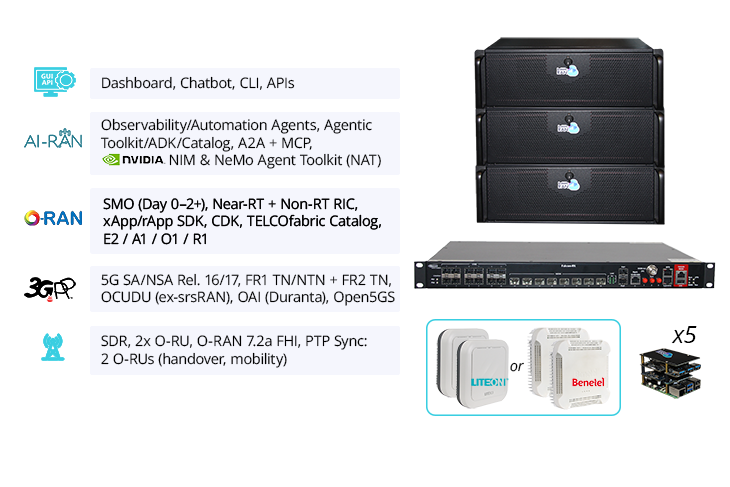
MX-PDK AI-RAN gives telecom R&D and engineering teams a complete, licensed, and validated multi-vendor 5G/6G O-RAN and agentic AI-RAN platform with two live cells. It combines the full MX-PDK O-RAN foundation with multi-cell radio infrastructure, reusable telecom agents, agentic observability and automation, and AI development tools in one reproducible environment.
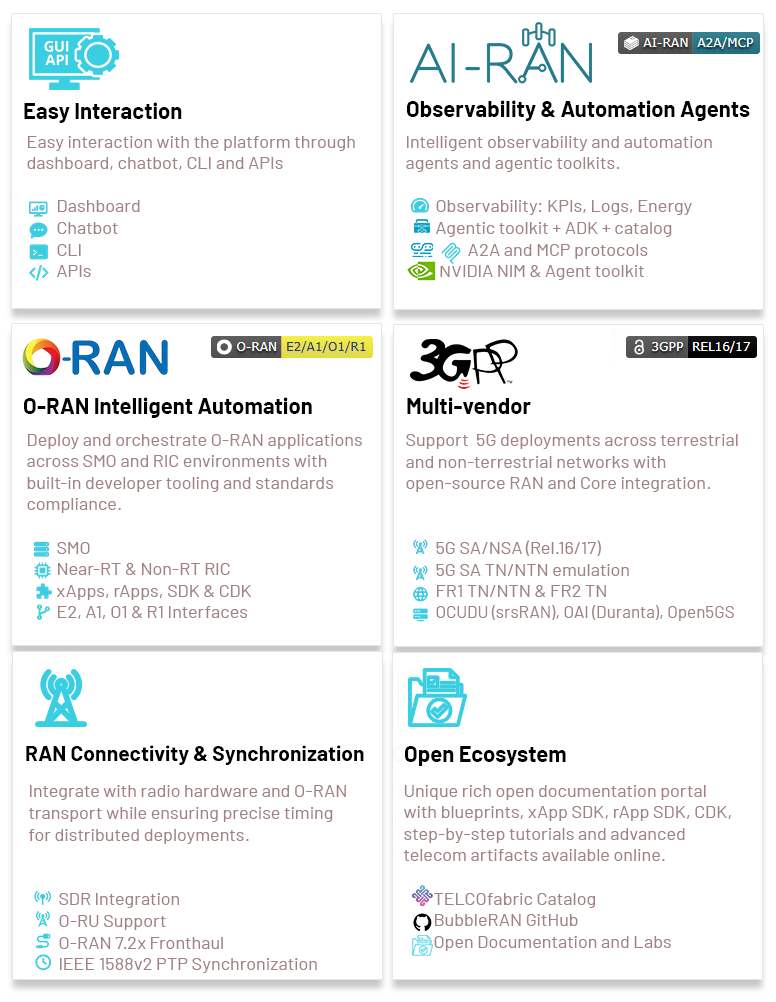
It is an industry-grade AI-RAN platform supporting AI-for-RAN and AI-on-RAN applications and services, with built-in multi-agent Observability and Automation Blueprints. It includes a three-node O-Cloud, two industrial O-RUs, PTP-synchronized O-RAN 7.2 fronthaul, five Pictel 5G edge nodes, near-RT and non-RT RICs, xApp and rApp DevKits, the BubbleRAN Agentic Toolkit (BAT), reusable AI agents and blueprints, and A2A and MCP integration. Model endpoints can be local, on-premises, or remote, with support for NVIDIA NIM and NeMo integrations as well as OpenAI-compatible endpoints.
What makes MX-PDK AI-RAN different
- O-RAN: Run two live O-RAN cells with real mobility, handover, load-balancing, interference, and multi-cell control experiments.
- AI-RAN: Run built-in AI-for-RAN and AI-on-RAN applications and services for diverse use cases, ranging from IoT and edge AI to physical AI.
- Build: Use the included BAT Agent DevKit, ADK + CLI, to design, develop, test, package, benchmark, and publish telecom agents.
- Experiment: Go beyond observability with the included Observability and Automation Blueprints, connecting agents to the RIC, SMO/OAM, Kubernetes, and 5G network functions.
- Scale: Reuse your blueprints, xApps, rApps, and agents as your needs evolve toward Digital Twin-validated optimization and campus-scale deployments.
What can you do with MX-PDK AI-RAN?
- Develop and validate agentic RAN, core, and SMO workflows using reusable agents, A2A coordination, MCP tools, and permission-gated network actions.
- Experiment with multi-cell AI-RAN for mobility, handover, traffic steering, load balancing, interference management, slicing, SLA assurance, and QoS/QoE optimization.
- Build, benchmark, and compare telecom agents across different models, prompts, tools, and network conditions using the BAT Agent DevKit.
- Run AI-for-RAN and AI-on-RAN experiments, from network automation and root-cause assistance to edge AI and applications running alongside the RAN infrastructure.
- Build PoCs and prototypes for field validation using live O-RAN data and control surfaces, while carrying the same software artifacts into larger MX-PDK deployments.
What arrives in the box?
MX-PDK AI-RAN hardware
- 3x pre-installed O-Cloud workstation nodes, running the BubbleRAN O-Cloud with optimized Kubernetes, device discovery, Cilium networking, Multus, and eBPF-based observability.
- 2x industrial O-RAN 7.2 Radio Units, with LITEON FlexFi as the default indoor O-RU and supported Benetel alternatives available, providing two live cells with up to 100 MHz of bandwidth and 4x4 MIMO in FR1.
- 1x FibroLAN Falcon-RX fronthaul and synchronization switch, providing a higher-capacity time-aware fabric with an IEEE 1588v2 PTP grandmaster, GPS and local synchronization, PTP switching, QoS, and VLAN support.
- 5x Pictel 5G edge nodes, based on Raspberry Pi 5 and Quectel RM500Q with SIM cards, providing movable Ubuntu-based terminals for multi-UE, mobility, MEC, and AI-on-RAN experiments.
- Required accessories, including 25GbE O-RAN fronthaul connectivity, antennas, RF, Ethernet, and SFP cables, power supplies, adapters, and connectivity accessories.
The hardware can be extended with additional O-Cloud capacity, indoor or outdoor O-RUs, SDRs, commercial UEs and CPEs, on-premises GPUs, and multi-cell or multi-site configurations.
MX-PDK AI-RAN software
MX-PDK AI-RAN support and software updates
The MX-PDK software license includes one year of software updates and technical support. Model endpoints, model subscriptions, optional local GPU resources, hardware, radio, and support scope can be configured to your project requirements.
Your day-one blueprint
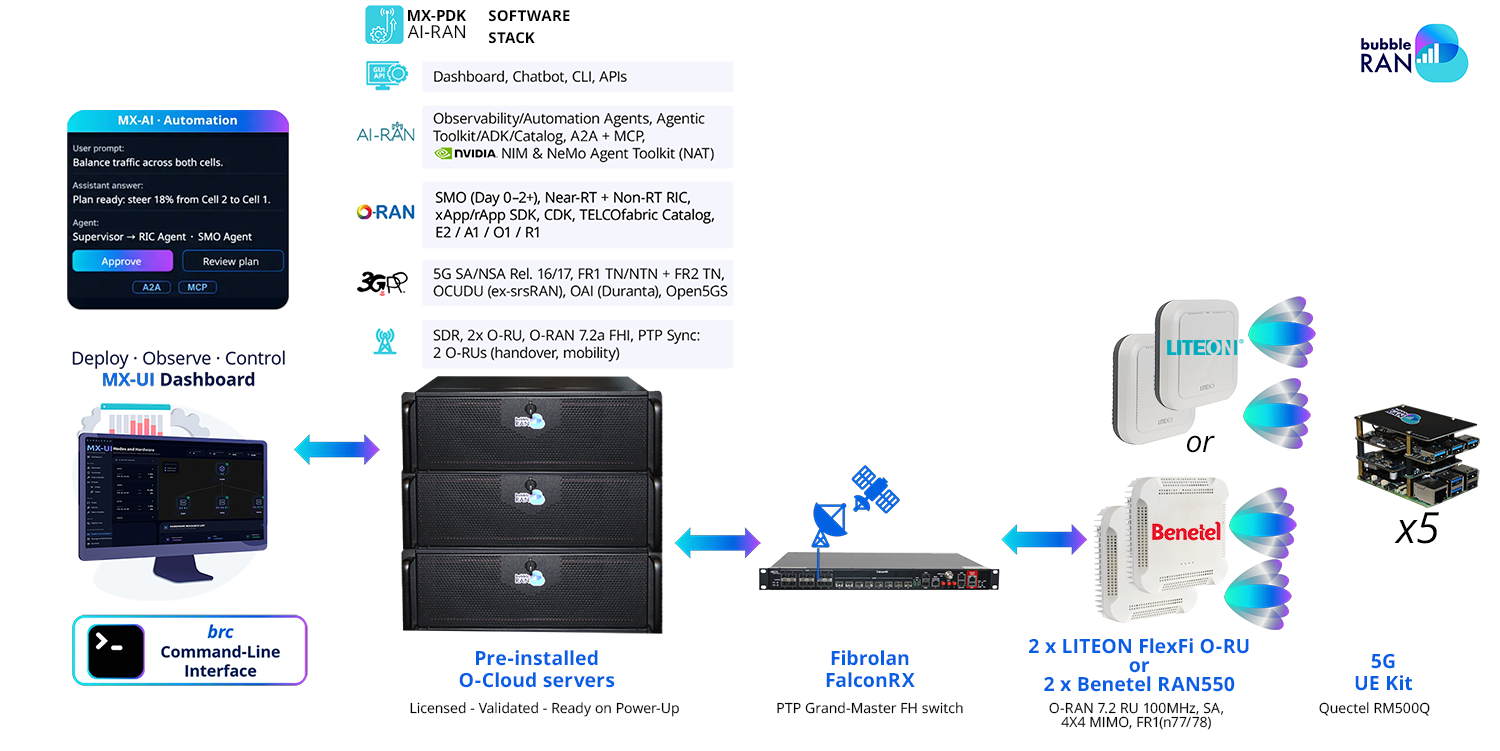
MX-PDK AI-RAN ships pre-installed, pre-configured, and validated with deployment blueprints that bring together two live O-RAN cells and an agentic control layer. The default setup combines the three-node O-Cloud, two synchronized O-RUs, near-RT RIC, xApps, a 5G core, five mobile edge nodes, and the included Observability and Automation Blueprints.
bash$ git clone https://github.com/bubbleran/blueprints && cd blueprints
bash$ brc install network network/OAI/liteon/05-two_liteon.yaml   # deploy two live cells and core
bash$ brc install terminal network/Terminals/terminal_quectel.yaml
bash$ brc install aifabric observability.yaml                    # deploy observability agents
bash$ brc install aifabric automation.yaml                       # deploy intent-to-action agents
bash$ brc observe network                                        # observe cells, UEs, RIC, and agents
Or start from any blueprint in the TelcoFabric portal and deploy it from the dashboard or the command line.
| Element | What gets deployed |
|---|---|
| Access | Two OAI O-CU/O-DU chains driving the O-RUs over O-RAN 7.2 fronthaul, with the default validated setup using band n78, 100 MHz, and up to 4x4 MIMO per cell |
| Radio | Two LITEON FlexFi O-RUs, or supported Benetel alternatives, synchronized by the Falcon-RX PTP grandmaster, providing two live cells |
| Core | Open5GS 5G core with an eMBB slice |
| Terminals | Five Pictel 5G edge nodes for mobility, traffic generation, MEC, and application-in-the-loop experiments |
| RIC and apps | Near-RT RIC with monitoring and handover-control xApps, plus non-RT RIC and rApp capabilities for A1/R1 workflows |
| Data | Network, RAN, application, infrastructure, logs, and metrics data available to the platform data layer and observability stack |
| AIFabric | The included Observability Blueprint and Automation Blueprint, with agents coordinating through A2A and accessing tools, data, and control APIs through MCP |
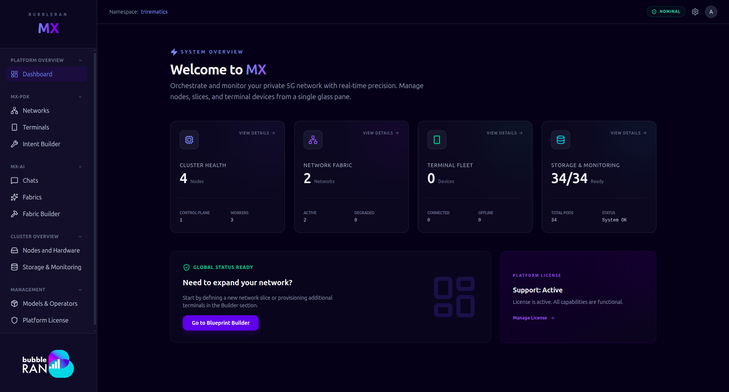
MX-UI gives you an immediate view of the complete AI-RAN environment, including cluster health, active networks, both live cells, terminal state, RIC components, workloads, agents, and observability data in one place.
The included Automation Blueprint turns high-level intent into a proposed sequence of network actions. A Supervisor coordinates RIC and SMO agents over A2A and MCP, while permission gates keep network-changing actions under explicit user control.
For example, ask “Balance traffic across both cells”. The Supervisor can analyze live telemetry, build a plan, delegate the required RIC and SMO tasks, and present the proposed action for approval before it reaches the network. This provides a controlled environment for evaluating what agents observe, decide, and change on a real multi-cell O-RAN deployment.
From there, use the BAT Agent DevKit to compose your own agents and blueprints, benchmark different models on the same telecom task, and publish reusable artifacts through TelcoFabric.
What the agentic AI-RAN suite adds
MX-PDK AI-RAN packages telecom intelligence as reusable AIFabric blueprints, compositions of agents, model endpoints, MCP servers, and control interfaces declared in YAML and deployed as Kubernetes resources.
| Included capability | What it gives you |
|---|---|
| Observability Blueprint | Full-stack Observability Planner with cluster, logs, and metrics agents over cluster-health, VictoriaLogs, and VictoriaMetrics MCP servers |
| Automation Blueprint | Intent-driven network automation using a Supervisor with SMO, RIC, and API agents to turn high-level requests into validated network actions |
| AIFabric controller | Kubernetes CRD and controller that reconciles blueprints into running agents and MCP servers, manages dependencies, and tracks health and status |
| A2A and MCP | Agent-to-agent discovery and task delegation, plus standardized access to tools, data, algorithms, models, and control APIs |
| BAT Agent DevKit | ADK and CLI to scaffold, implement, test, package, publish, and benchmark agents with reproducible task suites, latency, accuracy, and token-usage metrics |
| Model flexibility | Per-agent model choice using on-premises Ollama, NVIDIA NIM, NeMo Agent Toolkit, remote APIs, or OpenAI-compatible endpoints |
| AI-for-RAN / AI-on-RAN | Agentic intelligence for RAN operations and automation, plus AI workloads and applications running alongside the RAN infrastructure |
| Reusable ecosystem | Compose custom agents, MCP servers, API adapters, or models, then publish and reuse them through TelcoFabric |
The Optimization Blueprint is the next step. It adds closed-loop configuration optimization with what-if validation before rollout and requires a Network Digital Twin, available with MX-PDK CAMPUS.
From AI-RAN to campus-scale optimization
Scale the same software foundation as your experiments move from multi-cell agentic AI-RAN to Digital Twin-validated optimization and campus-scale infrastructure.
| Next step | What it adds |
|---|---|
| Optional on-premises GPU | Local model inference and acceleration for selected AI/ML and edge workloads. |
| Additional O-Cloud capacity | More compute for concurrent networks, heavier AI workloads, and larger test campaigns. |
| Additional or outdoor O-RUs | Larger radio footprints, more live cells, and experiments beyond the indoor lab. |
| MX-PDK CAMPUS | Enterprise compute, indoor and outdoor radio options, GPU acceleration, Network Digital Twin, Optimization Blueprint, energy visibility, and campus-scale deployment. |
| MX-DT | Network Digital Twin capabilities for what-if experimentation, model-driven scenarios, and validation alongside the live network. |
The blueprints, xApps, rApps, agents, APIs, datasets, and operational workflows you build on MX-PDK AI-RAN carry forward across the MX-PDK range. Compare the range →
Who it is for
- AI-RAN research teams: A validated environment for building and evaluating AI agents against live RAN telemetry and real network control surfaces.
- Telecom R&D teams: A multi-cell O-RAN platform for mobility, handover, load balancing, interference, slicing, SLA assurance, and intelligent network automation.
- Agent and application developers: An integrated environment for BAT-based agent development, benchmarking, A2A/MCP workflows, edge AI, and applications in the loop.
- Research institutions and universities: An industry-grade platform for AI-for-RAN, AI-on-RAN, TN/NTN, O-RAN, ISAC, sensing, and autonomous-network research.
- Test labs and system integrators: A reproducible multi-vendor environment for validating AI-driven workflows before moving them toward larger or field deployments.
Scale and 5G/6G capabilities
MX-PDK AI-RAN extends the common MX-PDK O-RAN foundation with three O-Cloud nodes, two live O-RAN cells, five Pictel 5G edge nodes, agentic observability and automation, the BAT Agent DevKit, A2A/MCP workflows, and edge AI/application-in-the-loop capabilities. Everything below is included unless otherwise noted.
5G/6G radio and network
| Capability | MX-PDK AI-RAN |
|---|---|
| 5G stack | OpenAirInterface (R2.4.0), OCUDU (R24.06), and Open5GS, with 3GPP Release 17 support, including OCUDU UE and OAI UE soft terminals |
| Deployment modes | Standalone (SA) and Non-Standalone (NSA), monolithic gNB or CU/DU/RU split |
| TN/NTN | Terrestrial networking plus 5G NTN experimentation via OCUDU, including non-terrestrial emulation, with over-the-air NTN available as an option |
| Spectrum | FR1 over the air with the included O-RUs, with the default validated setup using n78, plus all TDD FR1 and limited FR2 support on the software platform |
| Bandwidth | Up to 100 MHz per cell and bandwidth part |
| Modulation | 256QAM in downlink and uplink |
| MIMO | Up to 4x4 downlink and 2x2 uplink per included O-RU configuration |
| Mobility | Xn, NG, and inter-DU handover between two live cells |
| Interfaces | E2, F1, NG, Xn, plus O-RAN 7.2a fronthaul |
| O-Cloud | 3 nodes, Kubernetes (Kubeadm), Cilium CNI with Multus, Harbor registry, eBPF observability |
| Radio units | 2 indoor O-RAN 7.2 O-RUs, LITEON FlexFi by default, with supported Benetel alternatives available |
| Fronthaul | O-RAN 7.2 FHI with PTP synchronization through the FibroLAN Falcon-RX grandmaster, with GPS and local synchronization |
| Commercial and edge UE fleet | 5x Pictel 5G edge nodes based on Raspberry Pi 5 and Quectel RM500Q with SIM cards |
| Emulated networks | Up to 4 gNBs + 16 soft UEs (OCUDU UE and OAI UE), with channel models |
| Over-the-air 5G | Included, with two live radio cells and commercial 5G edge nodes |
| On-premises GPU | Optional, scoped separately |
O-RAN programmability
| Capability | MX-PDK AI-RAN |
|---|---|
| Near-RT RIC | 300 µs to 1 ms control loop; E2AP v3.0 and A1AP v4.04 |
| Non-RT RIC | Included, with R1AP v8.0 or Kubernetes CRDs, plus A1AP v4.04 |
| E2 service models | KPM v3.0, RC v1.03, CCC v3.01, LLC v1.0, plus BubbleRAN Traffic Control, Slice Control, and L2 Statistics |
| xApp capabilities | Performance measurement and traffic steering, handover control, RAN reconfiguration, interference detection, and sensing from SRS I/Q samples |
| rApp capabilities | Intent-driven RAN automation, QoS/QoE optimization, SLA assurance, slice provisioning, and AI/ML deployment workflows |
| ISAC and sensing | LLC (Low Layer Control) service model over E2, providing access to SRS I/Q samples for sensing, positioning, interference detection, and object detection workflows |
| Development kits | xApp SDK (C, C++, Python), rApp SDK (Python), BAT Agent DevKit, and CDK, plus the TelcoFabric xApp, rApp, and AI agent catalog |
| O-RAN interfaces | E2, A1, O1, R1, and O-RAN 7.2a fronthaul workflows |
Agentic AI-RAN, automation, and operations
| Capability | MX-PDK AI-RAN |
|---|---|
| SMO/OAM operations | Day 0 in 1 to 5 s, Day 1 in 1 to 30 s, Day 2+ in 1 to 75 s |
| Northbound | Kubernetes CRDs (YAML), REST API, O1 interface, BubbleRAN CLI (brc) |
| Lifecycle scope | Resource discovery, NF onboarding, service design, scheduling, deployment, configuration, reconfiguration, testing, and upgrades |
| Observability | Multi-source data lake with RAN statistics, logs, traces, infrastructure usage, and energy consumption, plus Grafana dashboards |
| Agentic observability | Included Observability Blueprint with Planner, cluster, logs, and metrics agents |
| Agentic automation | Included Automation Blueprint with Supervisor, SMO Agent, RIC Agent, and API Agent |
| Agent development | Included BAT Agent DevKit, ADK + CLI, for development, packaging, testing, publication, and benchmarking |
| Agent protocols | A2A for agent-to-agent coordination, MCP for standardized access to tools, data, algorithms, models, and control APIs |
| Agent interfaces | API, CLI, and UI |
| Agent decision loop | Approximately 1 s to 1 min for agentic workflows, alongside the faster near-RT and non-RT RIC control loops |
| Model endpoints | Local or on-premises Ollama, NVIDIA NIM and NeMo Agent Toolkit, remote model APIs, or OpenAI-compatible endpoints; model subscriptions and optional GPU resources are scoped separately |
| AI-for-RAN / AI-on-RAN | Included platform support for AI-driven network operations and automation, plus edge AI and applications running alongside the RAN infrastructure |
| Network Digital Twin | Available with MX-PDK CAMPUS and MX-DT |
| Digital Twin-validated optimization | Requires a Network Digital Twin; included as part of the MX-PDK CAMPUS optimization path |
| Security | RBAC, network isolation, signed rootless artifacts, SBOM |
Ready to start?
- Explore deployment blueprints and sample networks
- Follow the guided labs
- Learn the BubbleRAN CLI (
brc) - See MX-PDK AI-RAN live, book a demo